
There is a kind of family video that nobody watches. It is forty minutes long. It opens with someone saying "Is this thing on?" It covers a whole life in order, from birth to the present, in the voice people use for a job interview. It was recorded once, with great effort, and it sits on a hard drive.
Then there is the other kind. It is three minutes long. It is about one thing: the pocketknife, the night the basement flooded, what your father said when you told him you were getting married. The person telling it forgets the camera halfway through. A grandchild watches it, and then watches it again, and then sends it to a cousin.
Here is how to make the second kind.
Pick one thing
The biggest mistake is trying to tell everything. Nobody can listen to a whole life, and you cannot tell one in a sitting. A story is about one object, one day, one decision, or one person. "Tell me about your childhood" produces nothing. "What did your mother's kitchen smell like on Sunday?" produces a story.
This is why Legacy Guard's guide asks one question at a time. It is not that the big questions do not matter. It is that the small ones are the only way in. Answer fifty small ones over a couple of years and you will have told the big story without ever trying to.
If you are stuck, use one of these:
- What is an object in your house that your grandchildren would not understand, and where did it come from?
- What was the first thing you ever bought with your own money?
- Who taught you the most, and what exactly did they say?
- What do you want your grandchildren to know about money?
- What is a tradition you hope the family keeps after you are gone?
- What was the hardest decision you ever made, and would you make it again?
Talk to one person
A recording aimed at "the family" sounds like a speech. A recording aimed at Emily sounds like a conversation. Before you press record, decide who this one is for, and say their name. "Emily, I want to tell you about the pocketknife, because one day it is going to be yours and you should know why it has a chip in the handle."
You do not have to record a separate story for every grandchild. One told to one person is still a gift to everyone else; they are overhearing something true. But choosing a person changes your voice, and your voice is the whole point.
Keep it under five minutes
Three is better. A short story gets watched; a long one gets saved for later and later never comes. If a story is really longer, break it into chapters, each with its own title, each one standing on its own. "The flood, part one: the night it started." "Part two: what we found in the morning."
Short also means you can do it again next week. The goal is not one perfect recording. It is a shelf of small ones.
Stop trying to sound good
The voice people use for formal recordings is the voice their grandchildren have never heard. Talk the way you talk at the kitchen table. Use the words you actually use. Lose your place and say so. Laugh at the wrong moment. Those are the parts a grandchild will play back, because those are the parts that sound like you.
If a sentence comes out wrong, keep going. Nobody will mind. If you really want a second take, record the whole story again rather than trying to patch one sentence; the second telling is usually better anyway.
Put the camera where your face is
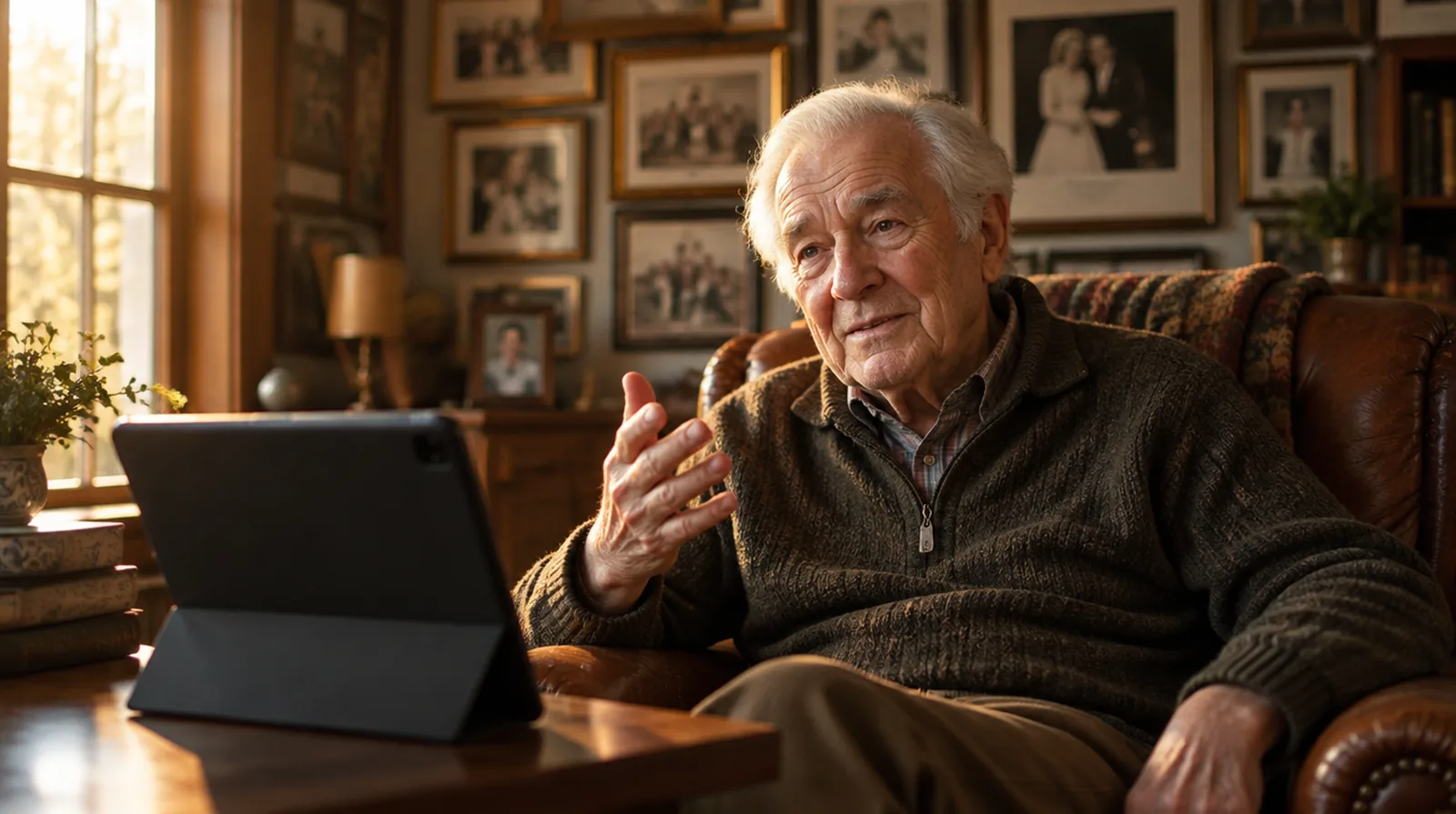
Set the phone or laptop at eye level, not on a table looking up at you. Sit near a window with the light on your face, not behind you. That is all the production you need. A plain wall or a bookshelf behind you is fine. The room noise is fine. Legacy Guard's recorder lets you pick a microphone and camera and test for three seconds before you begin, so you can hear what the recording will sound like and move the laptop if you need to.
If you hate being on camera, do not be. A voice recording carries almost everything a video does, and some people talk more freely without seeing themselves. Record your voice over a photo instead: hold up the picture of the house, or add it to the story afterward, and talk about what was happening when it was taken.
Say what it means
The facts of a story are the easy part. The meaning is what gets lost. After you tell what happened, add one sentence about why you are telling it. "I am telling you this because I want you to know that your great grandfather was not a hard man, he was a scared one, and he did his best." That sentence is the inheritance. Everything before it was the wrapping.
Decide who gets it, and when
Some stories are for now. A grandchild who just got engaged might want the one about how you met your spouse this week, not in twenty years. Some are for later: the letter you want read after you are gone, the thing you could not say out loud. Both are fine, and the choice should be yours for each one.
In Legacy Guard every story carries two questions: who is this for, and when should they receive it? The default is to keep it private and release it later, after a verified passing. Or you can share it today, and the person gets an email with a link that afternoon. Either way the story is encrypted on your own device before it is saved, so nobody but you can watch it until the moment you chose, not your spouse, not your attorney, not Legacy Guard.
Make it a habit, not a project
The families who end up with a real collection are not the ones who set aside a weekend. They are the ones who answered one question a week for a year. Twenty minutes on a Sunday. The guide sends a question; you record an answer or press Ask me later; the pile grows.
After five stories the guide starts to know you. After twenty it begins asking about the people in your stories, the ones you keep mentioning. By then you are not making recordings anymore. You are talking to your grandchildren, a few minutes at a time, and they will hear every word in your own voice.
A short checklist
- One story, one object or moment, under five minutes.
- Say the name of the person it is for.
- Camera at eye level, light on your face, or just your voice.
- Talk the way you talk. Keep going when you stumble.
- End with why you are telling it.
- Choose who receives it and when.
- Do it again next week.
That is the whole method. The pocketknife is waiting.